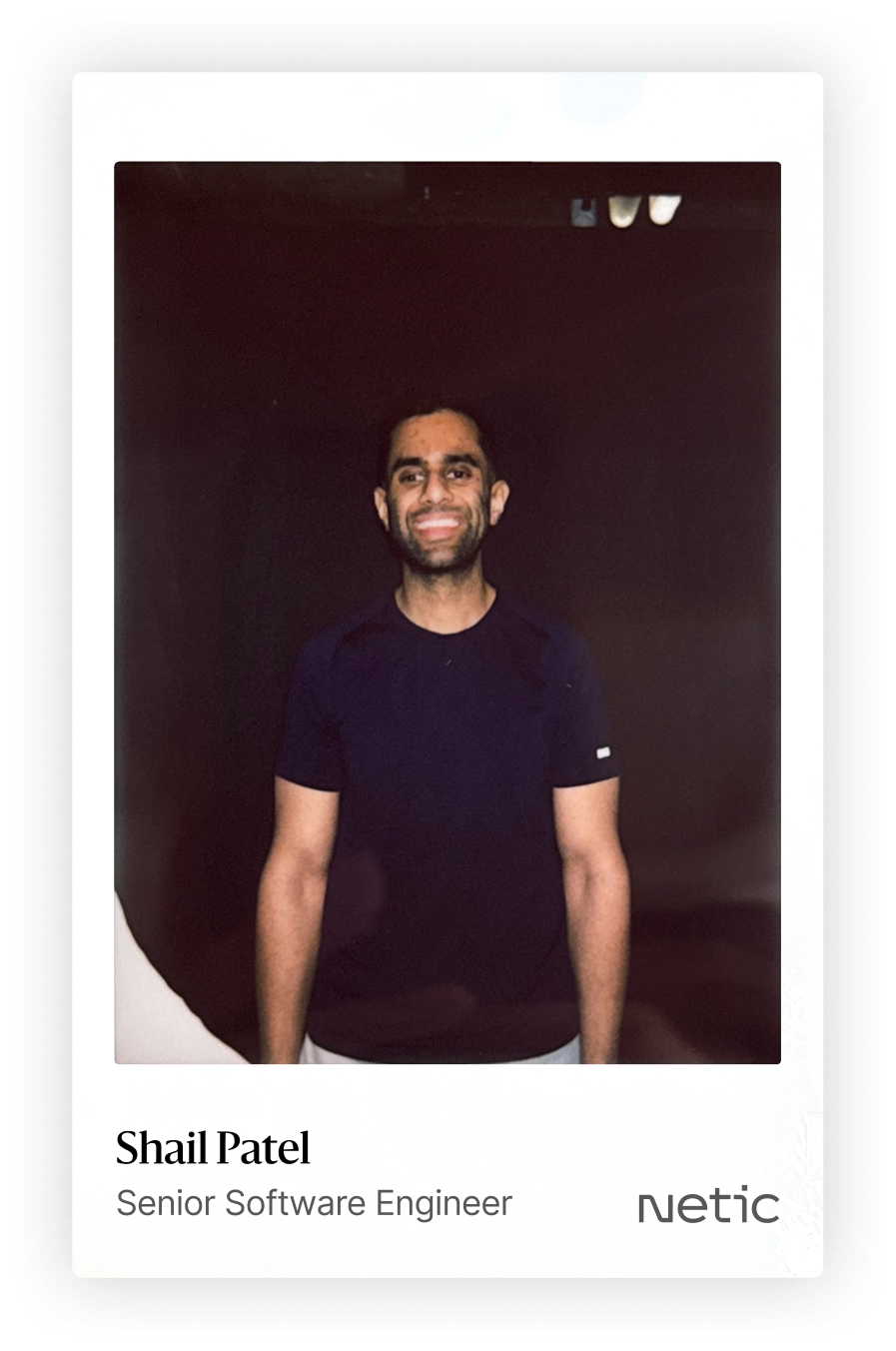
Before joining Netic, I spent almost five years at Rippling. When I started looking for my next role, I spoke with many companies. I wasn’t optimizing for a single factor. I was selective and looking for something that genuinely clicked.
Through the interview process, Netic became clear to me as a company helping essential service businesses grow on autopilot by building AI systems that run critical customer and operational workflows. The goal is to remove manual coordination so teams can focus on the core work of their business.
That clarity, combined with how the company actually operates day to day, is what made Netic click. Four things kept coming up, even after the interviews were over. The engineering challenges, the people, the customers, and the ambition.
Engineering Challenges
From an engineering perspective, Netic doesn’t just stitch together a handful of third party tools and call it AI. We are building our own agent framework from the ground up. That means owning the full stack, from how agents reason and plan, to how they interact with external systems, and how they recover when things go wrong.
A big part of the work is orchestration. Agents need to coordinate across multiple steps, maintain context over long running tasks, and make decisions under uncertainty. When something fails, and something always will, the system needs to degrade gracefully.
We also spend a lot of time bridging frontier research with production reality. New models and techniques unlock real capabilities, but they come with tradeoffs around cost, latency, and reliability. Turning research into something customers can depend on requires strong opinions, careful evaluation, and a willingness to say no when something is not ready. We need a system that can evaluate changes robustly while ensuring that the user experience doesn’t degrade.
To make this even harder, the same system has to support multiple industries, different customer workflows, and multiple modalities, all without fragmenting into one-off solutions.
The People
During the interview process, I spent close to 20 hours talking with people at Netic. What stood out was how often I kept thinking about those conversations afterward. Not just the formal interviews, but the casual chats in the office. People cared deeply about what they were building. More importantly, they cared about solving the right problems for customers, not just shipping features.
One moment that really stuck with me was chatting with Zi Gao. We talked about the challenges around building voice agents, the failure cases you only see in production, and the scaling problems that show up as usage grows. Even though Zi had only been at the company for a few months, you could tell he was completely consumed by the problem. He had thought deeply about the edge cases, the tradeoffs, and what the next set of constraints would look like.
That level of ownership is rare. It is even rarer to see it consistently across roles. Melisa might be the CEO, but everyone I talked to felt like a mini-CEO, each deeply accountable for their area.
The Customers
I have always found working with real customers deeply rewarding. At Rippling, the software we built was really critical for these businesses and high stakes. Few things were more important than getting people paid. One of the things that is compelling about Netic is that it touches similarly critical workflows.
At Netic, that impact goes a step further. We are building software for essential businesses that touch every American. The systems we build sit underneath industries like healthcare, veterinary care, home services, and trades like plumbing and electrical. These are businesses I interact with regularly and the same is true for my friends and family. Making these systems better does not just help a single company. It improves everyday experiences across the entire country.
The Scope and Ambition
There are many great companies solving narrow slices of an industry. Netic is aiming for something much bigger. The goal is to build a truly autonomous enterprise for essential businesses. We want to take work off people’s plates so they can focus on the real, concrete problems of their business rather than managing systems, workflows, and operations.
This is not a short term play. There is easily a decade of hard, meaningful work ahead. That long term ambition shows up in how Neticians think and what they prioritize. We can’t build solutions for one customer or even one industry. We have to build systems that are flexible, durable, and powerful enough to support the entire economy.
When you aim this high, incremental progress is not enough. Each person has to have an outsized impact. Ambitious goals attract people who want real ownership and are willing to take on hard problems. Those people then make the ambition achievable, which in turn raises the bar for who joins next. That flywheel is already spinning here.
Join Us
If you want to work with genuinely smart people, take real ownership, and solve difficult engineering problems that matter to the entire economy, we are hiring. This is a place for people who want to build things that last and are willing to aim high and shoot for the moon.

